Contents
- 1. Introduction
- 1.1 Purpose of this Statement
- 1.2 Scope
- 1.3 Data Governance Principles
- 2. Data Governance Roles
- 2.1 The School
- 2.2 Aionpixel
- 2.3 Authorised Users
- 2.4 Service Providers
- 3. Information Processed Through Cortex IOS
- 3.1 Data Categories
- 3.2 School-Required Demographic Information
- 3.3 Children's and Student Information
- 4. Data Lifecycle
- 4.2 Collection or Receipt
- 4.3 Validation and Association
- 4.4 Transmission
- 4.5 Storage
- 4.6 Authorised Access
- 4.7 Processing and Use
- 4.8 Authorised Sharing and Integration
- 4.9 Retention
- 4.10 Archive, Deletion or De-identification
- 5. Data Processing Overview
- 5.1 Typical Student Information Flow
- 5.2 Mobile Application Flow
- 5.3 Payment Processing Flow
- 5.4 Communication Flow
- 5.5 AI-Assisted Feature Flow
- 6. Data Retention, Deletion and Backup Governance
- 6.1 Retention Framework
- 6.2 Retention Categories
- 6.3 Why We Do Not Publish Arbitrary Retention Periods
- 6.4 School-Controlled Retention
- 6.5 User Account Deactivation
- 6.6 Privacy Deletion Requests
- 6.7 Backup Governance
- 6.8 Tenant Off-boarding
- 7. Data Classification Approach
- 7.1 Purpose
- 7.2 Information Classification Levels
- 7.3 Handling Expectations
- 8. Third-Party Services and Subprocessors
- 8.1 Purpose
- 8.2 Categories of Service Providers
- 8.3 Information Shared
- 8.4 Selection of Providers
- 8.5 Provider Responsibilities
- 8.6 School-Directed Integrations
- 8.7 Transparency
- 9. Artificial Intelligence Data Governance
- 9.1 Guiding Principles
- 9.2 AI Processing Scope
- 9.3 Human Oversight
- 9.4 Future AI Features
- 10. Governance, Accountability and Compliance
- 10.1 Governance Framework
- 10.2 Shared Responsibility
- 10.3 Policy Review
- 10.4 Relationship with Other Documents
- 11. Data Governance Enquiries
1. Introduction
1.1 Purpose of this Statement
Cortex IOS is a cloud-based School Operating System developed and operated by Aionpixel Technologies Private Limited ("Aionpixel", "we", "our", or "us").
Educational institutions use Cortex IOS to support academic, administrative, financial, operational, communication, human resource, and learning activities.
These activities may involve the processing of information relating to students, children, parents and guardians, teachers, School staff, School management, and other authorised users.
This Data Governance Statement explains, at a high level, how information moves through the Cortex IOS environment and how data governance principles are applied across the information lifecycle.
It is intended to answer five fundamental questions:
What types of information may be processed through Cortex IOS?
Why is that information processed?
How does information move through the platform?
How is retention and deletion approached?
Which parties or service providers may participate in processing?
This Statement supplements the Cortex IOS Product Privacy Policy.
1.2 Scope
This Statement applies to information processed through Cortex IOS services, including, where enabled:
- web portals
- mobile applications
- School administration functions
- student information management
- academic and assessment functions
- learning management
- fee and accounting functions
- human resource functions
- communication services
- authorised APIs
- approved integrations
- technical support
- security operations
- backup and recovery processes
The specific data processed by a School depends on the Cortex IOS modules, features, workflows, and integrations enabled for that School.
1.3 Data Governance Principles
Our data governance approach is guided by the following principles.
Purpose-Based Processing
Information should be processed for an identified educational, administrative, operational, security, contractual, or legal purpose.
Data Minimisation
Schools and authorised users should collect and process information appropriate to the intended purpose.
The existence of a configurable field within Cortex IOS does not require every School to collect that information.
Role-Based Access
Information should be available only to users whose authorised roles and responsibilities require access.
Tenant Separation
Cortex IOS is designed to separate School tenant environments through logical access and application controls.
Accountability
Significant administrative, authentication, security, and other supported activities may be logged to support accountability and investigation.
Retention Limitation
Information should not be retained indefinitely without an appropriate educational, administrative, legal, security, or contractual purpose.
Security by Design
Security considerations are incorporated into the design and operation of Cortex IOS.
Transparency
Aionpixel seeks to explain material data processing practices through public privacy, governance, security, and transparency documentation.
2. Data Governance Roles
2.1 The School
For most educational and School administrative activities, the School determines:
- what information is required
- why the information is required
- which School processes use the information
- which users should have access
- which Cortex IOS modules are enabled
- which reports are generated
- which integrations are enabled
- applicable School-level record requirements
The School is responsible for ensuring that its collection and use of information is appropriate for its educational, administrative, statutory, and operational purposes.
2.2 Aionpixel
Aionpixel provides and operates the Cortex IOS technology platform.
Aionpixel may process School information to:
- host Cortex IOS
- store authorised information
- execute application workflows
- provide authorised user access
- maintain security
- provide technical support
- maintain backups
- support integrations
- monitor platform reliability
- investigate incidents
- comply with applicable contractual or legal obligations
For certain limited corporate, security, support, billing, fraud-prevention, and legal activities, Aionpixel may determine the purpose and manner of its own processing.
2.4 Service Providers
Aionpixel may use service providers to perform specific technical or operational functions.
A service provider may process limited information necessary for its function.
Examples may include infrastructure hosting, communication delivery, payment processing, notifications, diagnostics, security, or AI-assisted services where enabled.
Service-provider transparency is addressed further in Section 8.
3. Information Processed Through Cortex IOS
3.1 Data Categories
Depending on School configuration, Cortex IOS may process the following categories of information:
| Data Category | Illustrative Information |
|---|---|
| Student Identity | Name, date of birth, photograph, student identifier |
| Student Demographics | Gender, nationality, religion, caste/category, mother tongue |
| Socio-Economic Information | Family income, income category, scholarship eligibility |
| Parent & Guardian Information | Name, relationship, contact information, address |
| Admission Information | Applications, documents, previous School information |
| Academic Information | Subjects, marks, grades, competencies, report cards |
| Learning Information | Assignments, submissions, learning activities |
| Attendance | Presence, absence, leave and attendance history |
| Health & Welfare | Allergies, support requirements, disability information where enabled |
| Fee Information | Fee structures, invoices, concessions and balances |
| Payment Information | Transaction status, payment references and gateway references |
| Accounting Information | Authorised financial and accounting records |
| Transport Information | Routes, pickup points and vehicle assignments |
| Staff Information | Identity, employment, department and designation |
| Payroll Information | Payroll-related information where enabled |
| Communications | Messages, notices, chats, circulars and acknowledgements |
| Documents and Media | Certificates, photographs, forms and attachments |
| Device Information | Device type, operating system and application version |
| Network Information | IP address and session-related information |
| Authentication Information | Login and session information |
| Audit Information | Administrative, security and significant platform events |
| Support Information | Support requests and diagnostic information |
| AI Feature Information | Feature-specific inputs and outputs where enabled |
Not every School processes every category.
3.2 School-Required Demographic Information
Educational institutions may require demographic information for School records, authorised government reporting, scholarship administration, educational programmes, inclusion initiatives, or other legitimate purposes.
Depending on School requirements, Cortex IOS may support information such as:
- religion
- caste
- category or community classification
- nationality
- mother tongue
- socio-economic information
- family income
- disability information
- scholarship information
- government or educational identifiers
Aionpixel provides configurable technology to support School workflows.
The School determines whether a particular data field is required and appropriate for its authorised purposes.
3.3 Children's and Student Information
Student information forms a significant part of the Cortex IOS data environment.
Aionpixel does not independently collect student information to create consumer advertising profiles.
Student information is generally processed in connection with School-directed educational, administrative, operational, or statutory activities.
Aionpixel does not sell student personal information.
4. Data Lifecycle
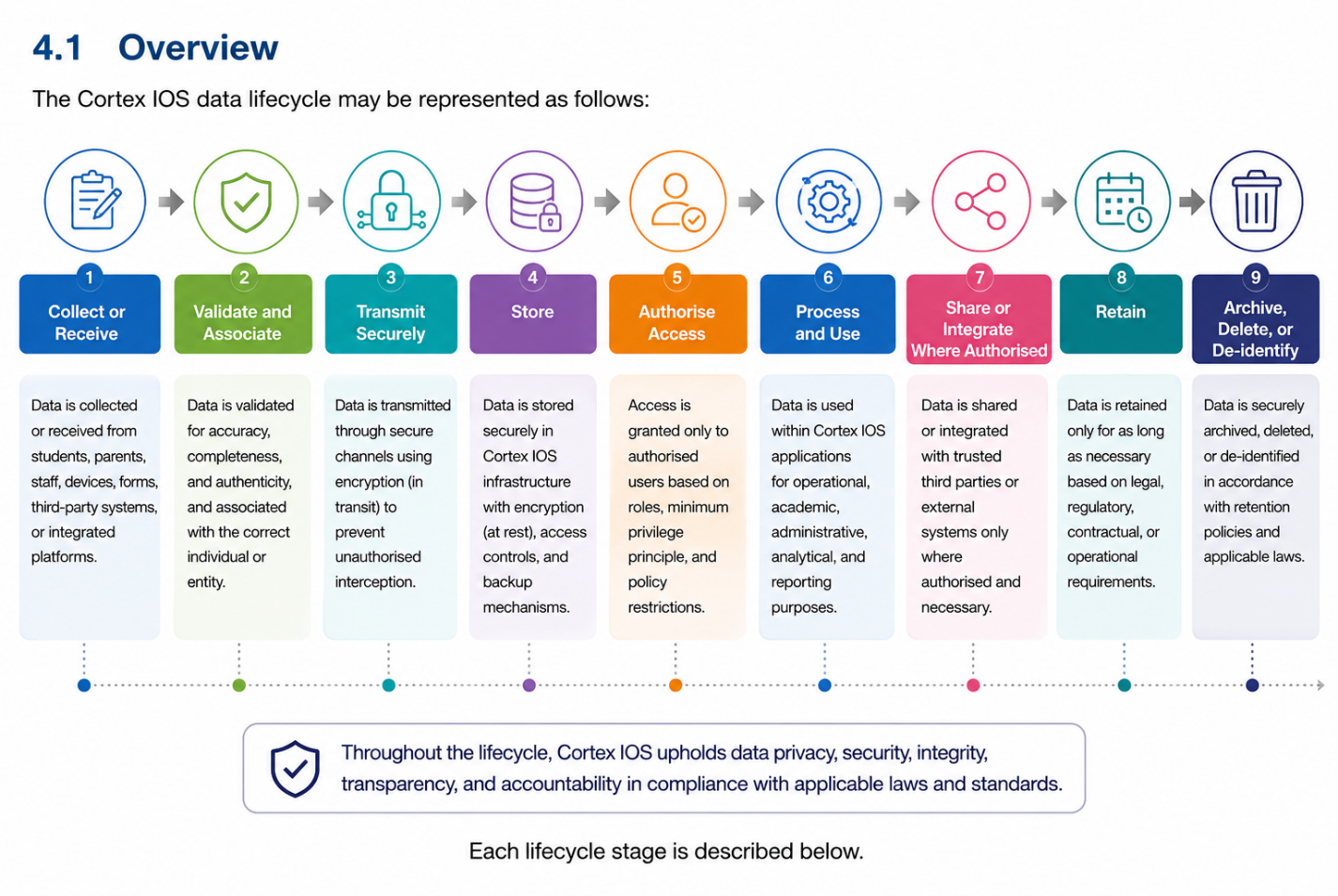
4.2 Collection or Receipt
Information may be received from:
- Schools
- authorised School administrators
- parents or guardians
- students
- teachers
- School staff
- bulk data imports
- data migrations
- authorised integrations
- technical platform activity
The mobile application does not provide general public registration or independently create Cortex IOS user accounts.
Mobile users must already have an authorised Cortex IOS account provisioned through applicable School or web-platform workflows.
4.3 Validation and Association
Information may be associated with relevant Cortex IOS records, including:
- School tenant
- School
- academic year
- student
- parent or guardian
- staff member
- user account
- class
- division
- transaction
- workflow
- other applicable platform entity
Schools and authorised users are responsible for providing accurate information and correcting identified inaccuracies through available processes.
4.4 Transmission
Information transmitted between supported Cortex IOS clients and platform services is intended to use secure communication protocols.
Information may also be securely transmitted to an authorised service provider or integration where required to perform a specific function.
4.5 Storage
Information may be stored within authorised Cortex IOS cloud infrastructure and associated platform services.
Storage arrangements may depend on:
- the type of information
- platform architecture
- service configuration
- backup requirements
- security requirements
- applicable contractual arrangements
Access to stored information is subject to applicable platform and operational controls.
4.7 Processing and Use
Information may be processed to perform authorised Cortex IOS functions.
Examples include:
- calculating attendance
- generating report cards
- displaying academic information
- creating fee demands
- recording payments
- generating receipts
- delivering communications
- producing authorised reports
- maintaining audit records
- executing workflows
- supporting School operations
Processing does not necessarily involve disclosure to a third party.
Much of Cortex IOS processing occurs within the platform to perform School-configured functions.
4.9 Retention
Information is retained according to its purpose and applicable requirements.
Educational records may have different retention needs from technical logs or temporary diagnostic information.
Cortex IOS does not apply a single universal retention period to all information.
4.10 Archive, Deletion or De-identification
At the appropriate lifecycle stage, information may be:
- retained in an authorised archive
- deleted from active systems
- de-identified
- anonymised where technically and legally appropriate
- maintained because an applicable retention requirement continues
Deletion from an active system may not immediately remove information from protected backup copies.
Backup information is addressed further in Section 6.
5. Data Processing Overview
5.1 Typical Student Information Flow
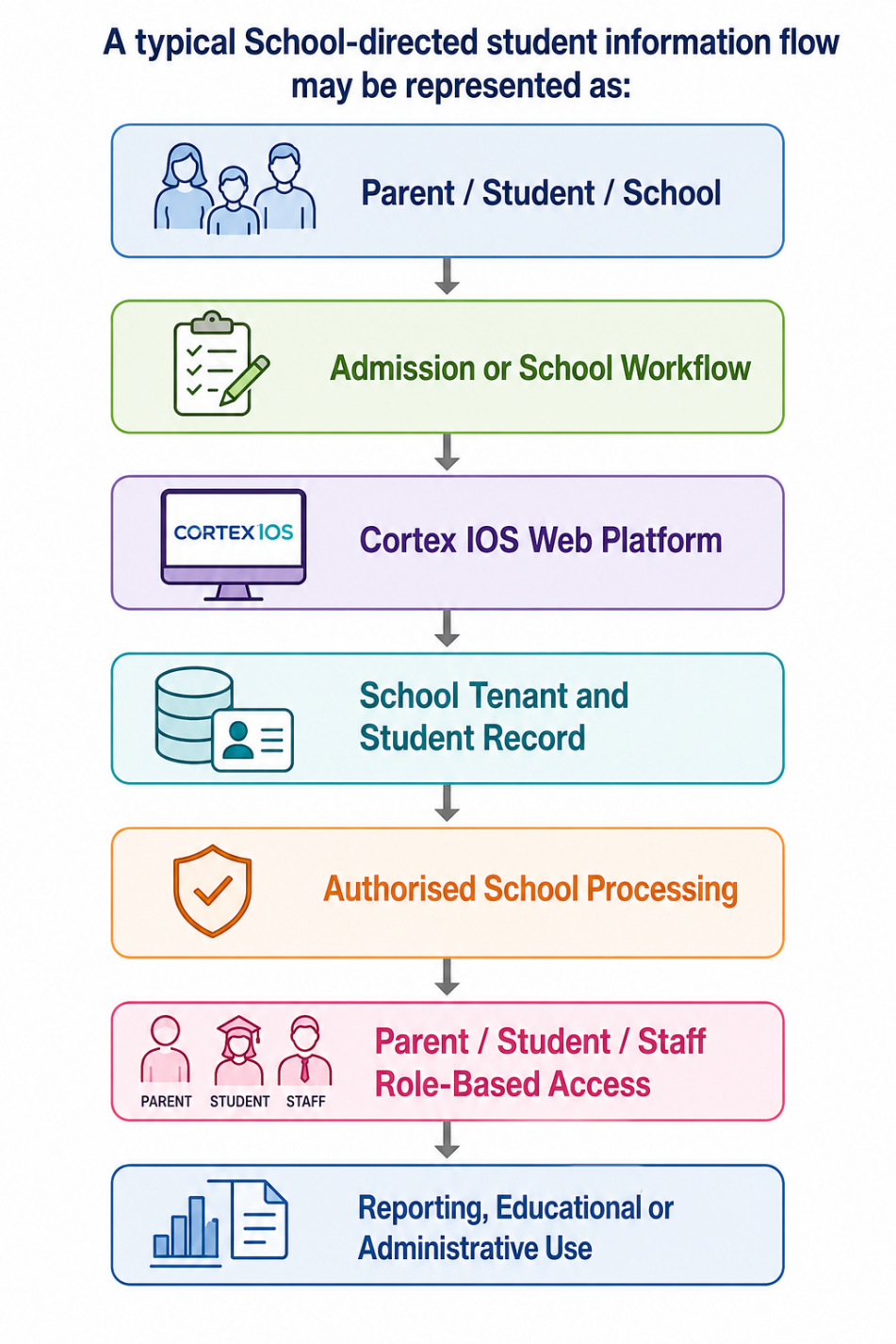
The specific flow varies according to the School and enabled modules.
5.2 Mobile Application Flow
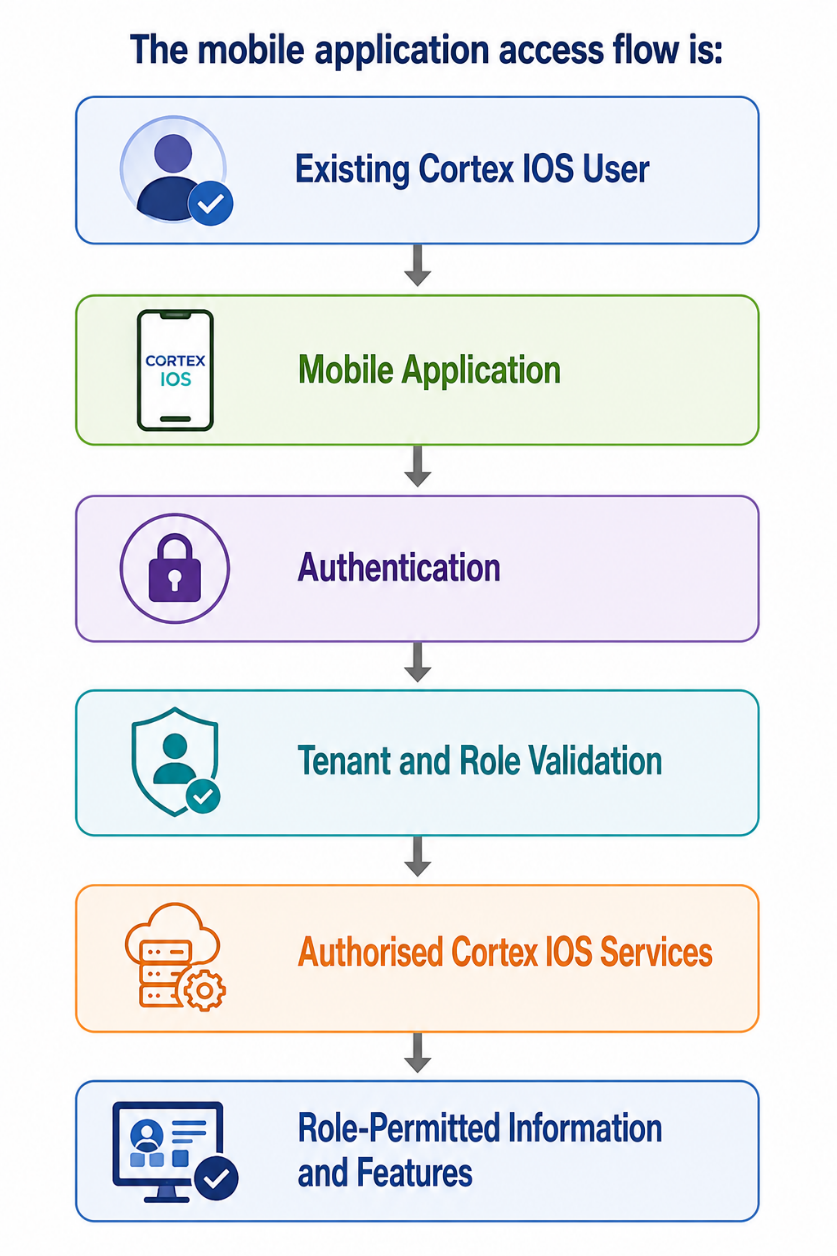
The mobile application does not independently create a new Cortex IOS user account.
An authorised user may, however, submit information through mobile features after authentication.
5.3 Payment Processing Flow
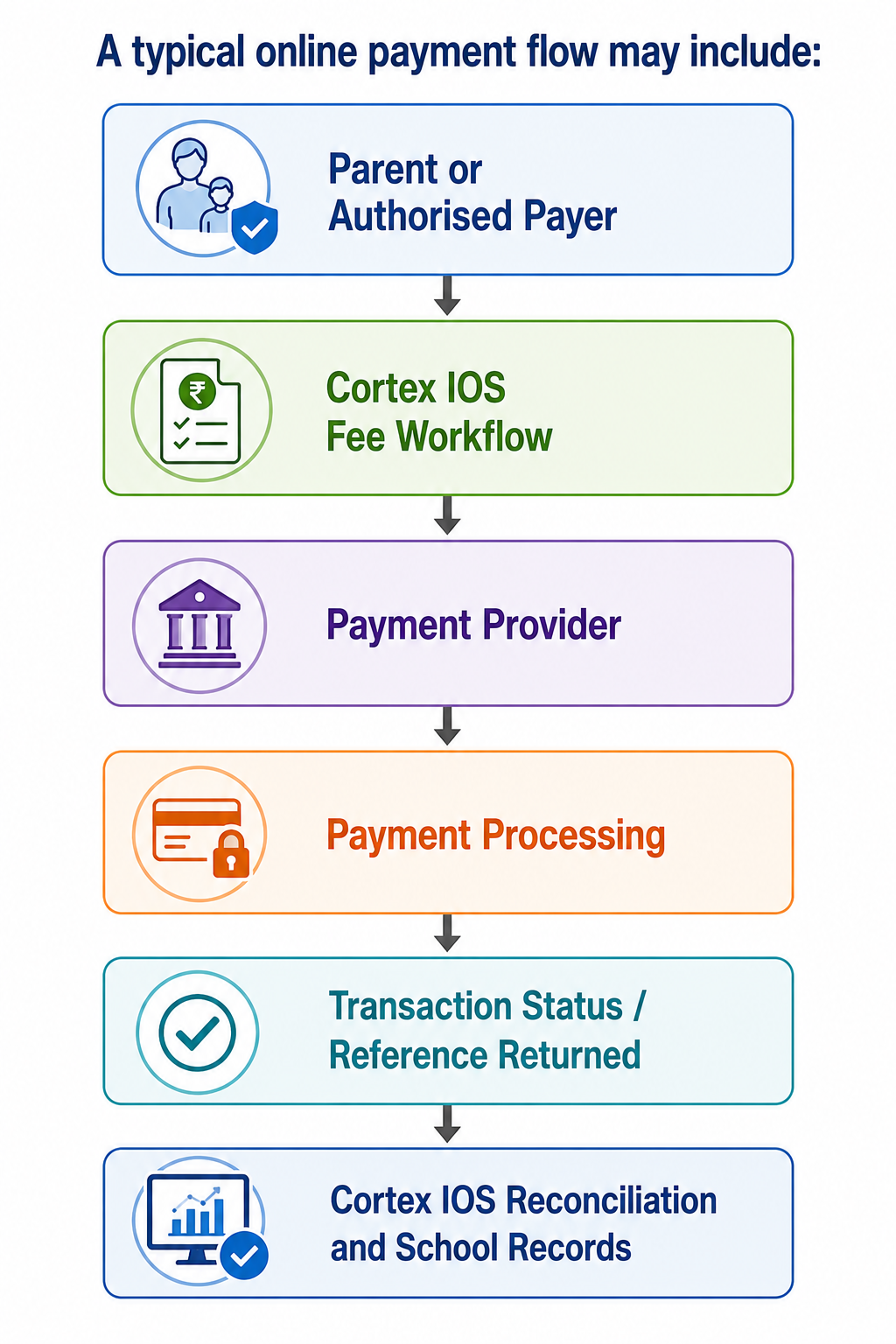
The exact information processed depends on the payment integration.
Sensitive payment credentials may be processed directly by the payment provider.
5.4 Communication Flow
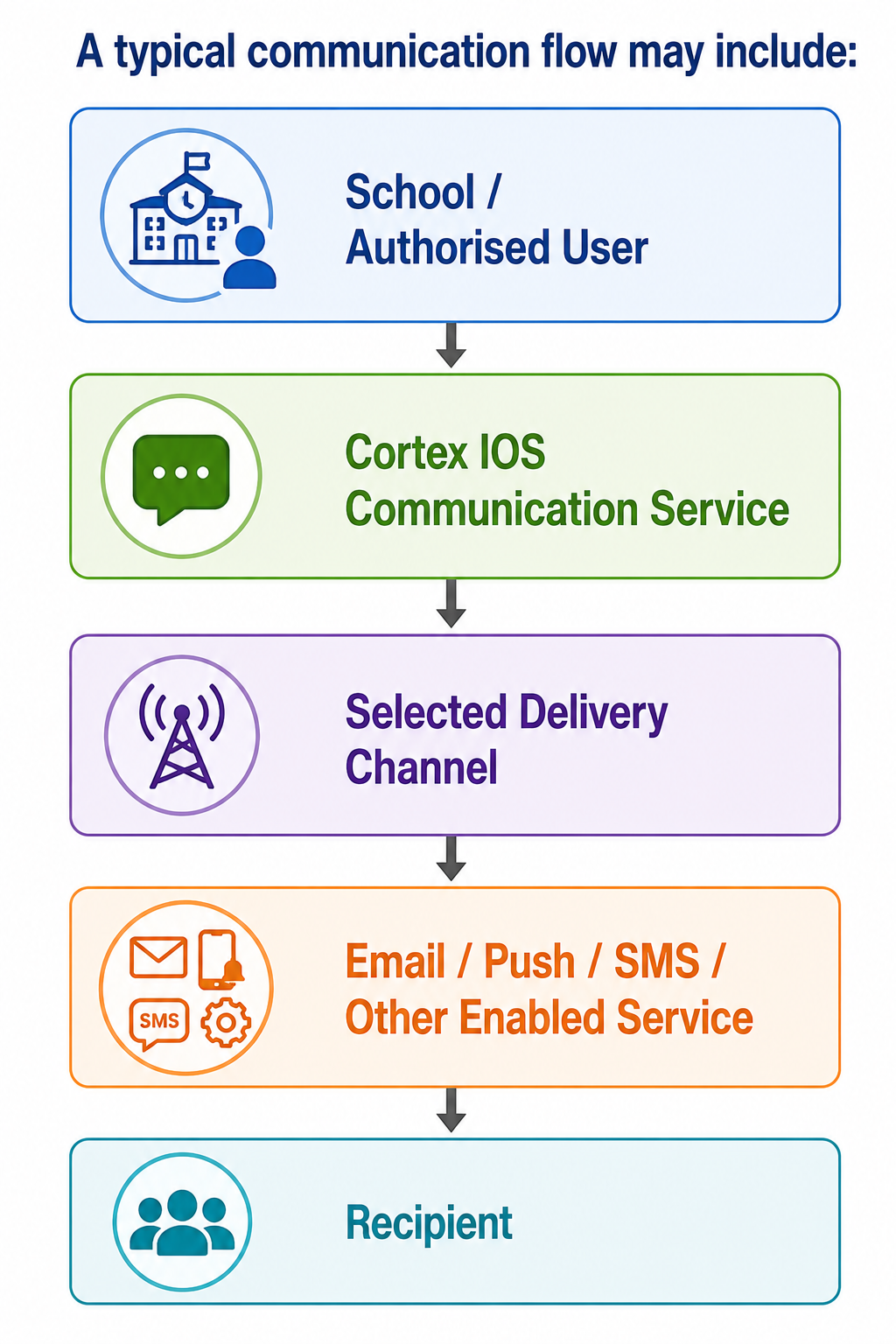
Delivery information or status may be returned to Cortex IOS where supported.
Essential School communications may be treated differently from optional communications.
5.5 AI-Assisted Feature Flow
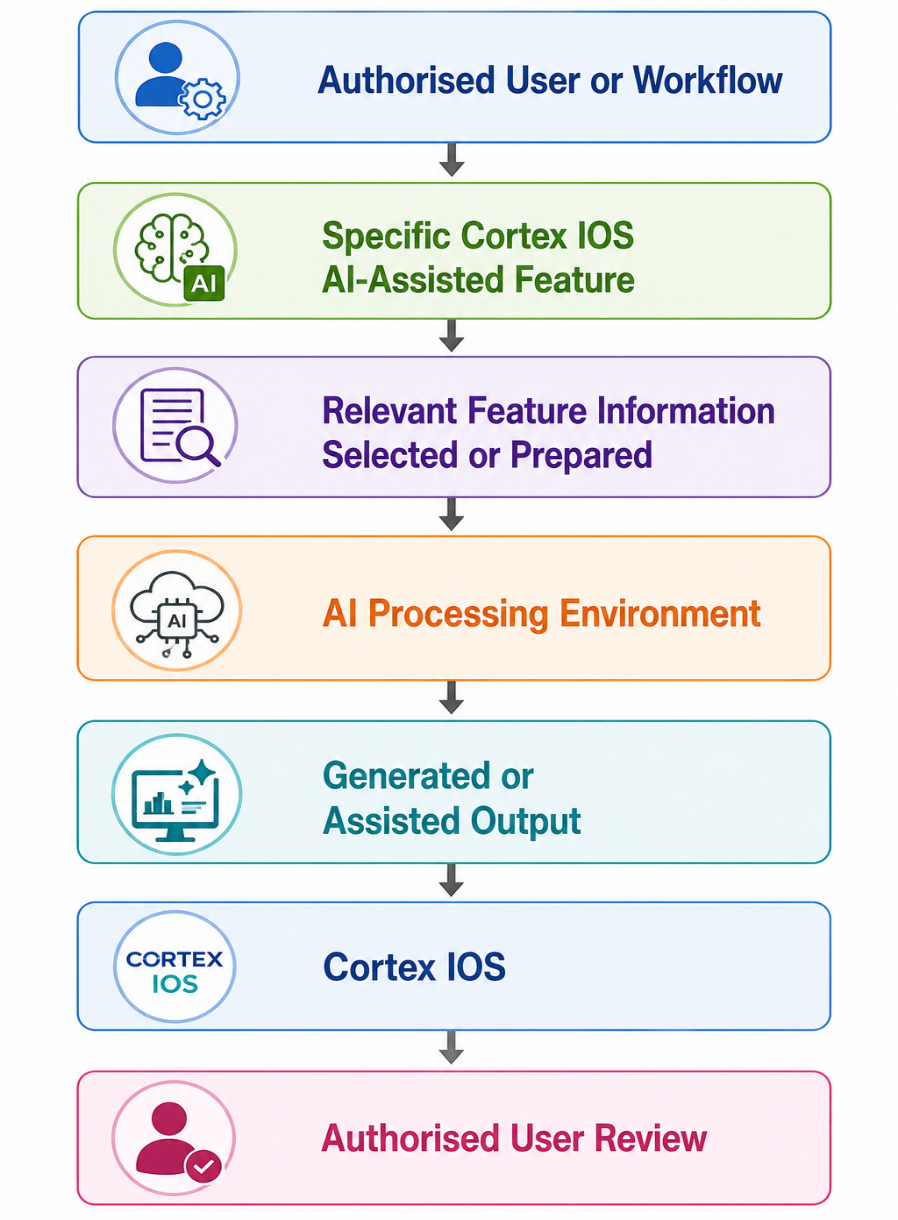
Where an AI-assisted feature is enabled, a typical high-level flow may include:
The exact flow depends on the AI feature.
The presence of AI functionality does not mean that the complete Cortex IOS database or all student records are automatically transmitted to an AI provider.
Feature-specific data handling should reflect the actual technical implementation.
6. Data Retention, Deletion and Backup Governance
6.1 Retention Framework
Cortex IOS applies a category-based approach to retention.
Retention decisions may consider:
- the purpose of processing
- the nature of the record
- School requirements
- educational requirements
- financial requirements
- employment requirements
- statutory obligations
- security requirements
- contractual commitments
- investigations or disputes
- applicable law
6.2 Retention Categories
The following table describes the general retention approach.
| Information Category | General Retention Approach |
|---|---|
| Student Identity Records | School relationship and applicable School or educational record requirements |
| Academic Records | School and applicable educational record requirements |
| Attendance Records | School and applicable educational or statutory requirements |
| Parent & Guardian Records | School relationship and associated student record requirements |
| Admission Records | School admission and record requirements |
| Fee Records | School, financial and accounting requirements |
| Payment Records | Transaction, reconciliation, financial and legal requirements |
| Staff Records | Employment, School and legal requirements |
| Communications | School purpose, operational need and applicable retention requirements |
| Uploaded Documents | Purpose of collection and associated School record requirements |
| Authentication Records | Security and operational requirements |
| Security Logs | Security monitoring, investigation and audit requirements |
| Diagnostic Information | Troubleshooting and platform reliability requirements |
| Support Records | Support, contractual and operational requirements |
| Backup Copies | Defined resilience and recovery lifecycle |
| AI Feature Information | Feature design, provider configuration and applicable processing purpose |
This table describes retention principles and does not establish a fixed universal number of days or years for every School record.
6.3 Why We Do Not Publish Arbitrary Retention Periods
Cortex IOS supports different educational institutions and record types.
A single statement such as "all data is deleted after 30 days" would be inaccurate and inappropriate for educational records.
For example:
- an application diagnostic record may be required temporarily
- a payment record may be required for financial purposes
- an academic record may form part of a student's educational history
- a security event may need to be retained for investigation
Aionpixel seeks to align retention with the purpose and requirements applicable to the relevant information category.
6.4 School-Controlled Retention
Schools may establish retention requirements for School-controlled information, subject to applicable law and Cortex IOS contractual arrangements.
Aionpixel may provide tools or processes to support:
- data review
- archival
- export
- deletion
- de-identification
- tenant offboarding
The availability and implementation of these processes may depend on the relevant Cortex IOS module and contractual arrangement.
6.5 User Account Deactivation
Account deactivation is distinct from data deletion.
When a user's access is disabled:
- the user may no longer be able to sign in
- active sessions may be terminated according to applicable controls
- the user's role or permissions may be removed; but
- associated School records may remain retained
The Cortex IOS mobile application does not provide an instant self-service account deletion function.
Accounts are managed through authorised School or platform workflows.
6.6 Privacy Deletion Requests
A user may request deletion of eligible personal information through applicable privacy request channels.
The request may require:
- identity verification
- relationship or authority verification
- identification of relevant information
- School review where School-controlled records are involved
- retention assessment
- deletion or de-identification of eligible information
- communication of the outcome
Information subject to an applicable retention requirement may continue to be retained.
6.7 Backup Governance
Cortex IOS may maintain backup copies to support:
- disaster recovery
- business continuity
- accidental data-loss recovery
- service resilience
- security recovery
Backups are not intended to function as ordinary user-accessible archives.
Where information has been validly deleted from active systems, residual copies may remain within protected backups until the applicable backup lifecycle expires.
If a backup is restored for legitimate recovery purposes, applicable operational processes should account for previously completed deletion requirements where technically and operationally appropriate.
6.8 Tenant Off-boarding
When a School ends its Cortex IOS subscription, data handling may include:
- School-authorised export
- transition support where agreed
- access termination
- retention for an agreed transition period
- deletion from active systems
- backup lifecycle expiry
- retention of limited information required for legal, security, billing, or contractual purposes
The applicable process is governed by the School's agreement with Aionpixel and relevant data processing arrangements.
7. Data Classification Approach
7.1 Purpose
Cortex IOS adopts a risk-based approach to information governance.
Different categories of information require different levels of protection depending upon:
- the nature of the information
- the potential impact of unauthorised disclosure
- legal or regulatory obligations
- School requirements
- educational sensitivity
- operational necessity
The classifications described below are intended to communicate the general level of protection expected for different categories of information. They do not replace the School's own information classification policies.
7.2 Information Classification Levels
Public
Information approved for unrestricted public disclosure.
Examples include:
product brochures;
marketing material;
publicly available policies;
publicly available help documentation;
Trust Centre documents; and
publicly released announcements.
Unauthorised modification of public information remains prohibited.
Internal
Operational information intended for authorised Aionpixel personnel or authorised School personnel.
Examples include:
- operational procedures
- internal support documentation
- routine operational reports
- internal project documentation
- configuration guidance
product roadmaps; and
internal communications.
Internal information should not normally be published without authorisation.
Confidential
Information requiring controlled access because of business, educational, operational, financial, employment, or privacy considerations.
Examples include:
- student records
- parent information
- staff records
- academic records
- attendance
- fee information
- accounting records
- School operational records
- communications
- uploaded documents
- technical support records
- customer configuration information
Most information processed through Cortex IOS falls within this classification.
Restricted
Information requiring the highest level of protection because unauthorised disclosure could significantly affect individuals, Schools, or platform security.
Examples may include:
- authentication credentials
- password-related information
- cryptographic material
- privileged administrative credentials
- security investigation records
- vulnerability information
- security monitoring data
- privileged audit records
- security incident evidence
- other information requiring enhanced protection
Restricted information should be accessed only by specifically authorised personnel.
7.3 Handling Expectations
The classification assigned to information influences:
- access permissions
- storage controls
- transmission requirements
- operational handling
- monitoring
- retention considerations
- disposal methods
- incident response
Not every information category within Cortex IOS receives identical treatment.
Controls should be appropriate to the sensitivity of the information involved.
8. Third-Party Services and Subprocessors
8.1 Purpose
Aionpixel may engage carefully selected third-party providers to support the operation, security, reliability, communication, and delivery of Cortex IOS.
These providers perform specific services and are not granted unrestricted access to customer information.
Only information reasonably necessary for the relevant service should be processed.
8.2 Categories of Service Providers
Depending on the Cortex IOS deployment and enabled functionality, third-party providers may support:
- cloud infrastructure
- database hosting
- content delivery
- email delivery
- SMS delivery
- push notifications
- payment processing
- authentication
- application monitoring
- diagnostics
- analytics
- security
- customer support
- backup
- disaster recovery
- AI-assisted services
- other technical platform functions
The actual providers used may change over time as Cortex IOS evolves.
8.4 Selection of Providers
When selecting service providers, Aionpixel seeks to consider factors including:
- security capability
- operational reliability
- technical suitability
- contractual protections
- confidentiality
- regulatory requirements
- privacy practices
- service availability
- business continuity considerations
Provider evaluation may differ according to the type of service being procured.
8.5 Provider Responsibilities
Service providers are expected to process information only to perform the services for which they have been engaged.
Where appropriate, Aionpixel seeks contractual commitments relating to:
- confidentiality
- information security
- authorised processing
- incident notification
- subcontracting controls
- return or deletion of information
- compliance with applicable contractual obligations
8.6 School-Directed Integrations
A School may request or enable integrations with third-party systems.
Examples may include:
- finance systems
- communication services
- identity providers
- payment providers
- learning resources
- government reporting systems where supported
- other authorised educational services
The School remains responsible for determining whether such integrations are appropriate for its environment.
8.7 Transparency
Aionpixel may maintain and periodically update information regarding material categories of subprocessors or technical service providers through the Cortex IOS Trust Centre.
The list may evolve as services, infrastructure, or providers change.
9. Artificial Intelligence Data Governance
9.1 Guiding Principles
Artificial Intelligence capabilities within Cortex IOS are governed by the same principles that apply to other platform functionality, including:
- educational purpose
- transparency
- proportionality
- privacy by design
- security by design
- human oversight
- accountability
- responsible innovation
9.2 AI Processing Scope
The presence of AI within Cortex IOS does not mean that all information processed by Cortex IOS is automatically submitted to AI services.
AI processing occurs only where:
- an AI-enabled feature exists
- the feature is enabled
- the requested function requires AI processing
- the technical implementation supports such processing
The information processed depends upon the specific feature.
9.3 Human Oversight
AI-assisted outputs are intended to assist authorised users.
Unless expressly stated otherwise, AI-generated content should be reviewed by the appropriate School personnel before being relied upon for significant educational, disciplinary, welfare, financial, or administrative decisions.
9.4 Future AI Features
As Cortex IOS evolves, additional AI-assisted capabilities may be introduced.
Where a new capability materially changes information processing, Aionpixel may:
- update the Product Privacy Policy
- update this Statement
- publish additional feature documentation
- update applicable provider information
- introduce School configuration controls
- provide additional notices where appropriate
10. Governance, Accountability and Compliance
10.1 Governance Framework
Information governance within Cortex IOS is supported through organisational, technical, and operational measures.
These measures may include:
- documented policies
- role-based responsibilities
- information security practices
- privacy governance
- operational procedures
- audit capability
- incident management
- change management
- periodic policy review
10.3 Policy Review
This Data Governance Statement will be reviewed:
- annually
- following significant platform changes
- following material legal developments
- following significant changes to processing activities
- where otherwise considered appropriate
10.4 Relationship with Other Documents
This Statement should be read together with:
- Cortex IOS Product Privacy Policy
- Information Security Statement
- Cookie & Similar Technologies Policy
- Platform Terms of Service
- Website Terms of Use
- Parent & Guardian Privacy Notice
- Student Privacy Notice
- School Staff Privacy Notice
- Legal & Transparency Statement
11. Data Governance Enquiries
Questions relating to data governance may be directed to:
- Privacy & Data Governance Team Aionpixel Technologies Private Limited
- Email: privacy@cortexios.com
- Website: https://www.cortexios.com
- Trust Centre: https://www.cortexios.com/trust
Where a request relates to School-controlled information, Aionpixel may coordinate with the applicable School to ensure that the request is addressed appropriately.
Annexure A – High-Level Data Lifecycle Summary
- Collect or Receive
- Validate & Associate
- Secure Transmission
- Protected Storage
- Role-Based Access
- Authorised Processing
- Approved Sharing / Integration
- Retention
- Archive / Delete / De-identify
This lifecycle represents the general governance approach adopted within Cortex IOS. The exact processing path depends on the enabled module, workflow, and School configuration.
Annexure B – High-Level Processing Matrix
| Processing Stage | Primary Responsibility | Supporting Responsibility |
|---|---|---|
| Collection | School / Authorised User | Cortex IOS |
| Validation | School | Cortex IOS |
| Secure Transmission | Cortex IOS | Infrastructure Providers |
| Storage | Cortex IOS | Infrastructure Providers |
| Role Assignment | School | Cortex IOS |
| Processing | School / Cortex IOS | Service Providers where applicable |
| Communication | School | Communication Providers |
| Payment Processing | School | Payment Provider / Cortex IOS |
| Backup | Cortex IOS | Infrastructure Provider |
| Deletion | School / Cortex IOS | Infrastructure Provider where applicable |
Annexure C – Version History
| Version | Date | Description |
|---|---|---|
| 1.0 | 16th July 2026 | Initial release of the Cortex IOS Data Governance Statement |